The sweltering heat in Nsanje is unforgiving. But Eunice Banda, a 43-year-old mother of four, seems oblivious to the heat as she wades through the forest of long sorghum stalks in her field, her baby securely strapped to her back. She pauses momentarily, a smile spreading across her sun-weathered face, as she caresses the budding fruit of her thriving crop.
Just a few years ago, life was far less kind to Banda. The creaky door falling off its frame and the rickety windows of her grass-thatched home tell the story of past struggles. For generations, maize had been the backbone of agriculture in Nsanje, but as climate change intensified, it became painfully clear that maize could no longer sustain families here. Droughts became more frequent, and harvests dwindled.
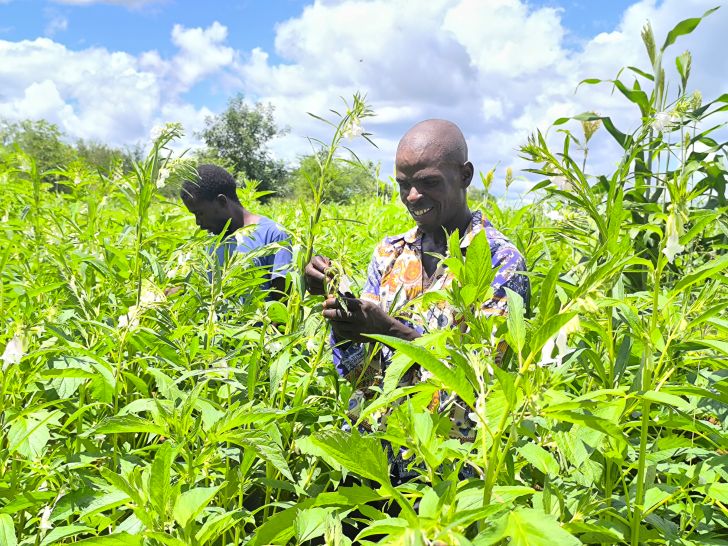
“Our area does not receive adequate rains, so these are the only alternative crops that do well here—sesame, sorghum, and millet,” Banda explains. “Before, our children were malnourished, and we did not have enough food in our homes. But now, we can sell part of our harvest and use the money to buy livestock, maize, school uniforms, and other necessities.”
With input from the World Foor Programme supported by the Evangelical Association of Malawi (EAM) programme, Banda planted 1.5 acres of sorghum and sesame in the 2023/24 season. She harvested seven bags of sorghum, keeping them all for household consumption, and five bags of sesame, which she sold, using the proceeds to buy school uniforms and goats.
“This year, from the same 1.5 acres, I expect to harvest not less than 15 bags of sorghum. We might sell two bags to cover some basic needs as we wait to harvest the sesame, which I cultivated on 2.5 acres. If all goes well, I might get at least K1 million and plan to buy a cow and more livestock,” she says, her eyes gleaming with newfound hope.
Levason Zanga, a 45-year-old father of five and chairperson of the Village Management Committee in T/A Mbenje, shares a similar story.
“Before I started cultivating sesame, my family faced so many poverty-related challenges. But in 2023, I harvested 10 bags from a 2.5-acre plot and earned K1 million. We bought a cow, clothes, and kitchen utensils and invested the rest in a village savings loan (VSL).”
The transition to cash crops has not only provided sustenance but also enabled farmers to plan for the future.
“This year, we are expecting to harvest 15 bags, which could fetch us K2 million. With this, we plan to buy more goats and cows and continue investing in VSLs. The challenge, however, is the unreliable market—vendors offer as little as K2 000 per kilogramme. We wish there were organisations buying sesame at fair prices,” Zanga adds.
Group Village Head Nyanjidu, who has overseen his community for 15 years, has seen firsthand how climate change has forced a shift in farming practices.
“Previously, we used to cultivate maize like other districts, but every year, we receive inadequate rains. We now rely on sesame and sorghum because they give us better yields.”
The WFP notes that recurring extreme weather events in drought-prone areas like Nsanje, Chikwawa, and Mangochi exacerbate food insecurity and malnutrition. To address these issues, Malawi Vision 2063 prioritises agricultural transformation toward climate-smart, high-value crops like cowpeas, sesame, and sorghum due to their drought tolerance, nutritional benefits, and market potential.
And the villagers are eager.
“When EAM and WFP provided us with sesame and sorghum seeds, we were excited. It renewed our hope in farming. Last year, I was able to buy 10 bags of maize with proceeds from sesame sales, about K300 000. Since transitioning from maize, we now eat nsima made from sorghum,” says GVH Nyanjidu.
Despite their resilience, farmers face significant hurdles. According to a Ministry of Agriculture and WFP value chain analysis targeting eight drought-prone districts, several systemic challenges hinder the full potential of these cash crops. One major challenge is the underdeveloped seed systems, which limit access to high-quality certified seeds, thereby reducing productivity. Strengthening seed systems by breeding and multiplying high-yield, climate-resilient varieties is crucial to improving farm outputs.
Farmers also struggle with unstable and unreliable markets, often forced to sell their produce at low prices to middlemen. Establishing structured markets and cooperatives would provide better bargaining power and income stability. Additionally, poor extension services mean that many farmers lack the necessary agricultural advisory support for production and marketing. Increased investment in research-extension-farmer linkages and improved frontline extension staff capacity would help bridge this gap.
Another challenge is the lack of policy prioritisation for cowpeas, sesame, and sorghum as alternative value chains. Integrating these crops into strategic policy frameworks and development plans would ensure their sustained growth. Similarly, low investment in research and development hampers productivity and market competitiveness. Increased funding for research would improve resilience and profitability.
Fragmented landholdings pose another barrier, as small and scattered plots make commercialisation difficult. Encouraging land consolidation and cooperative farming would enhance efficiency. Furthermore, inadequate storage and processing facilities contribute to high post-harvest losses, reducing profits. Promoting agro-processing, value addition, and access to affordable finance for storage facilities would enhance economic returns for farmers.
While challenges remain, farmers in Nsanje are proof that adapting to climate change through alternative crops is not just possible but profitable.
“We now have hope. We are making money, feeding our families, and investing in the future of our children,” Banda says. “If we can get better markets, nothing will stop us from achieving prosperity.”